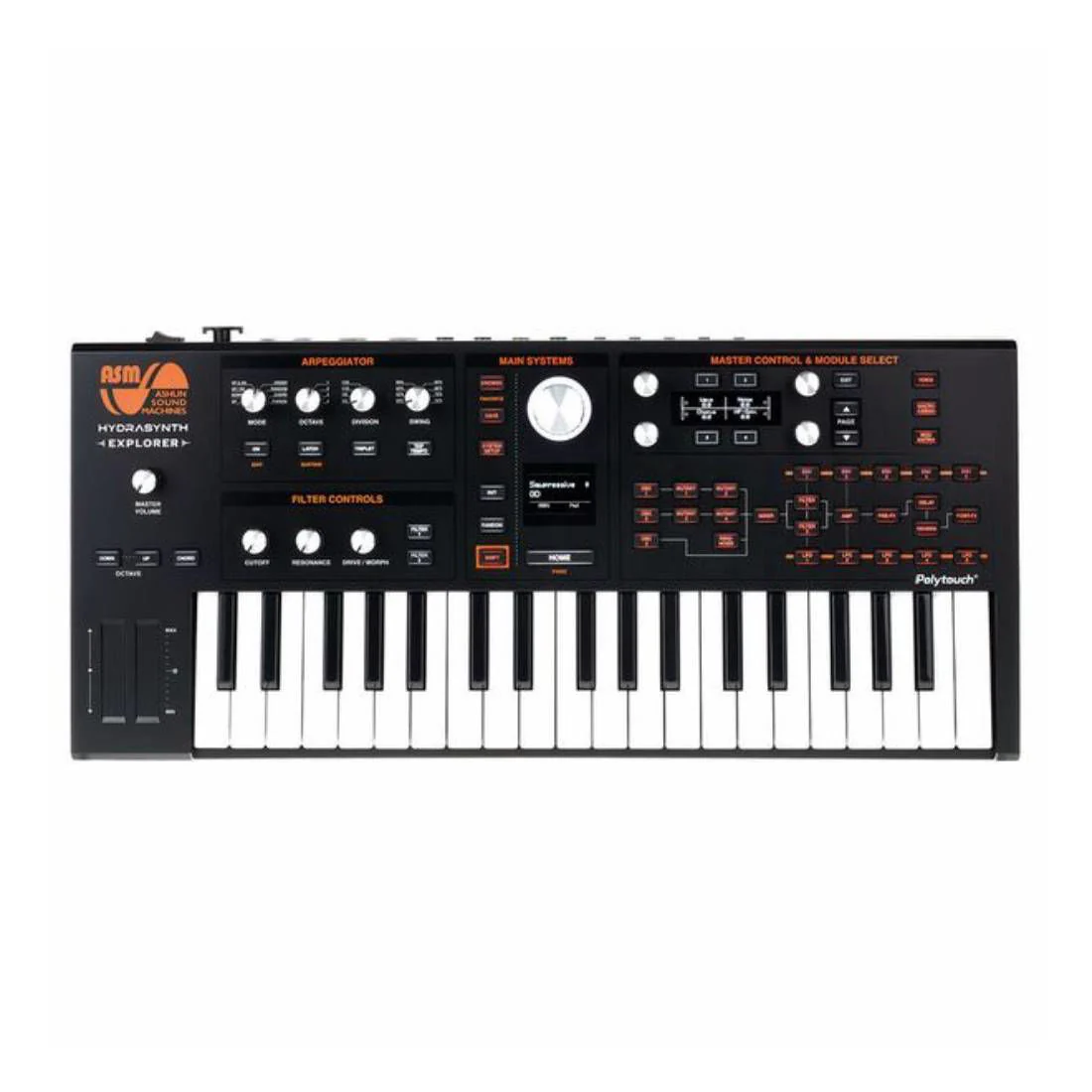
ASM Hydrasynth Explorer Digital Wave Morphing Keyboard Synthesizer
The greatest attention has been put to its user interface, making sound creation a breeze. This is the ultimate companion for a portable setup, where a smaller footprint in needed.
Utilizing an advanced wavetable synthesis engine, 3 Oscillators, dual Wave Mutators and 2 filters that can be configured in series or parallel, the tone generating capabilities are unmatched.
As for the performance capabilities, The HYDRASYNTH EXPLORER has our proprietary 37-note mid-sized Polytouch™ keybed that offers polyphonic aftertouch over each note, giving you the type of expressive control found only in certain vintage synths.
Features
- 8-voice polyphonic digital wave morphing synthesizer
- POLYTOUCH™ Polyphonic Aftertouch
- Note on/off velocity keyboard with 37 mid-sized keys
- Battery-powered operation using 8xAA batteries (not included)
- MPE (MIDI Polyphonic Expression) compatible
- Microtuning support via MIDI Tuning Standard files
- 3 Oscillators per voice with 4 Mutators total
- 1 Multimode filter and 1 variable LP-BP/Notch-HP filter per voice
- 640 program locations with Category search
- CV/Gate interconnectivity
Specifications
-
Steel top and bottom
-
Aluminum side panels
PolyTouch© Keybed
-
Semi-weighted
-
Polyphonic aftertouch
- Velocity
4 octave (67 cm, 26.4”) Ribbon controller
- Pitch bend mode
- CC control mode – modulation source
- Theremin mode - triggers envelopes and plays pitch
- Continuous pitch or choose from multiple scales
-
Support multiple CV/GATE standards
-
CV
-
1v per octave +/-5V
-
1V per octave 0-10V
-
Hz to Volts +/-5V
-
Hz to Volts 0-10V
-
1.2V per octave
-
-
Gates
-
V-trig, S-trig
-
3V, 5V, 10V
-
-
Mod In/Out range
-
+/5V, 0-10V, 0-5V, 0-1V
-
-
-
Clock in and out
-
1PPS, 2PPQ, 24PPQ, 48 PPQ
-
Clock Voltage - 3v, 5V, 10V
-
-
Voice overflow mode for expanding voices with another Hydrasynth
-
Polarity sensing input
USB port
-
Supports USB MIDI In/Out
(31.5 x 13.78 x 4.05 inches)
Weight
Watch: Hydrasynth Explorer Introduction
Product Information
Product Information
Shipping & Returns
Shipping & Returns
Description
The greatest attention has been put to its user interface, making sound creation a breeze. This is the ultimate companion for a portable setup, where a smaller footprint in needed.
Utilizing an advanced wavetable synthesis engine, 3 Oscillators, dual Wave Mutators and 2 filters that can be configured in series or parallel, the tone generating capabilities are unmatched.
As for the performance capabilities, The HYDRASYNTH EXPLORER has our proprietary 37-note mid-sized Polytouch™ keybed that offers polyphonic aftertouch over each note, giving you the type of expressive control found only in certain vintage synths.
Features
- 8-voice polyphonic digital wave morphing synthesizer
- POLYTOUCH™ Polyphonic Aftertouch
- Note on/off velocity keyboard with 37 mid-sized keys
- Battery-powered operation using 8xAA batteries (not included)
- MPE (MIDI Polyphonic Expression) compatible
- Microtuning support via MIDI Tuning Standard files
- 3 Oscillators per voice with 4 Mutators total
- 1 Multimode filter and 1 variable LP-BP/Notch-HP filter per voice
- 640 program locations with Category search
- CV/Gate interconnectivity
Specifications
-
Steel top and bottom
-
Aluminum side panels
PolyTouch© Keybed
-
Semi-weighted
-
Polyphonic aftertouch
- Velocity
4 octave (67 cm, 26.4”) Ribbon controller
- Pitch bend mode
- CC control mode – modulation source
- Theremin mode - triggers envelopes and plays pitch
- Continuous pitch or choose from multiple scales
-
Support multiple CV/GATE standards
-
CV
-
1v per octave +/-5V
-
1V per octave 0-10V
-
Hz to Volts +/-5V
-
Hz to Volts 0-10V
-
1.2V per octave
-
-
Gates
-
V-trig, S-trig
-
3V, 5V, 10V
-
-
Mod In/Out range
-
+/5V, 0-10V, 0-5V, 0-1V
-
-
-
Clock in and out
-
1PPS, 2PPQ, 24PPQ, 48 PPQ
-
Clock Voltage - 3v, 5V, 10V
-
-
Voice overflow mode for expanding voices with another Hydrasynth
-
Polarity sensing input
USB port
-
Supports USB MIDI In/Out
(31.5 x 13.78 x 4.05 inches)
Weight
Watch: Hydrasynth Explorer Introduction